Journal
Your children are learning to read you: emotional literacy and parenting
Every child grows up fluent in the language spoken at home. If the house speaks English, the child speaks English. If the house speaks Spanish, the child speaks Spanish. Nobody sits a two-year-old down for grammar lessons. They learn by listening.
Feelings work the same way. Your children are learning the language of emotion from you right now: what feelings are called, which ones are allowed, and what a person does when one gets too big. They are learning it at the dinner table, in the car and in the moment after you hang up a hard phone call. They are reading you long before they can read a book.
That can sound like pressure. I want you to hear it as hope. If emotional literacy is learned at home, it can be taught at home.
You cannot teach what you cannot read
Most parenting advice starts with the child. Emotional literacy starts with the parent.
In the 10P system, being emotionally literate means being able to read yourself, and being emotionally intelligent means choosing the right tool for what you read. A parent who cannot tell their own exhaustion from their own anger will have a hard time helping a child tell frustration from fear. Not because they do not love that child, but because you cannot hand someone a map you have never seen.
So the first question is not "What is wrong with my kid?" It is "What am I feeling right now?"
When your teenager rolls their eyes and something hot rises in your chest, read it. Is it anger? Or is it hurt, because you miss the child who used to run to the door when you came home? Is it fear about where they are headed? The tool you reach for depends on the answer. Anger tools will not fix hurt.
Under every behavior is a feeling
The second shift is seeing behavior as a signal, not a verdict.
A child who hits a sibling is not a bad kid. A teenager who slams a door is not a bad kid. No one is born bad. That is true in a prison, and it is true in a kitchen. Behavior is often the only language a child has for a feeling they cannot name yet. The tantrum may be overwhelm. The talking back may be embarrassment. The silence may be sadness that has nowhere to go.
This does not mean behavior has no consequences. It means consequences work better when the feeling underneath has been read first. Correct the behavior. Name the feeling. Both, every time.
Trade "calm down" for "what are you feeling?"
"Calm down" is a tool for the parent, not the child. It asks the child to make the feeling disappear without giving them any way to do it.
Try these instead:
- "What are you feeling right now?" If they do not know, offer two or three choices: "Are you mad, sad or scared?" Little ones can point to a face.
- "Where do you feel it?" In the stomach, the fists, the throat? This is how a child learns that feelings live in the body and can be noticed. The Body scan works for kids too.
- "That makes sense." You do not have to agree with what they did to agree that the feeling makes sense.
- "What would help?" A hug, a walk, a minute alone, a glass of water. Let them practice choosing a tool. That is emotional intelligence growing.
Repair is the real lesson
You will get it wrong. You will yell. You will say the thing your parent used to say to you, the one you swore you never would.
Good. Not because yelling is fine, but because what you do next is the most powerful lesson in emotional literacy a child can receive. Go back. Get down to their level. Say: "I was feeling overwhelmed and I yelled. That was not okay. It was not your fault. I am sorry." That is a Repair conversation, and a child who sees repair learns that relationships can survive big feelings.
Children do not need perfect parents. They need parents who come back.
Breaking the pattern
Many of us were raised by people who were never taught to read their own hearts. Their coping mechanisms became our coping mechanisms: the silence, the temper, the drinking, the working all the time so nobody has to talk. That is not an accusation. It is how unprocessed pain travels from one generation to the next.
The good news is that a pattern can be broken by one person in one house. When you learn the words, your children get the words. When you practice the tools, they inherit the tools. That is how a family changes, and that is how a community changes.
For families with a parent or loved one who is incarcerated, this work matters even more. When someone goes inside, the whole family serves the sentence. That is why 10P brings families into the learning alongside their loved ones, so healing can happen on both sides of the wall. You can read more in Emotional literacy for families.
Try this week: one word at the table
Pick one meal or one bedtime each day this week.
- Go around and say one feeling word each about your day. Parents go first and tell the truth. "I felt frustrated at work today."
- No fixing and no lectures. Just listen and say, "Thank you for telling me."
- Midweek, add "because." "I felt proud because I finished my project."
- By the weekend, add "and what helped was..." That is the full cycle: read it, understand it, respond to it.
If your children are old enough, have them take the Emotional Literacy Test with you and compare notes. The free app has a daily check-in and a word of the day you can use together. Our Circle check-in works at a dinner table as well as it works in a circle.
Your children are reading you. Give them something worth learning.
— Samual Nathaniel Brown
Put this into practice
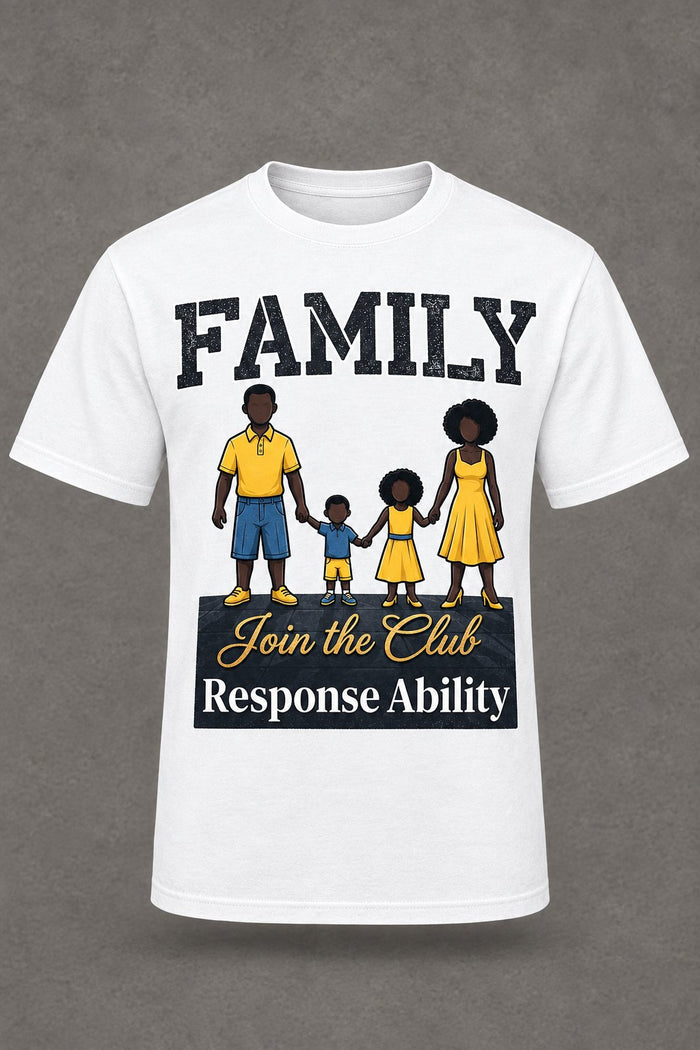 New Nubian Fashions
FAMILY “Response Ability” Tee
Response-ability is a family skill. More than just clothing, it’s a movement. $35.
Shop the tee
See also
Cite this entry: Samual Nathaniel Brown. “Your children are learning to read you: emotional literacy and parenting.” The Emotional Literacy Encyclopedia, 10P Program, 2026-10-26. https://emotionalliteracy.org/journal/your-children-are-learning-to-read-you/