Encyclopedia · People & programs
Nicole Brown
Community advocate and co-founder of Socc It to Autism whose work with 10P Warriors and Queens centers one idea: your past trauma is an experience, not your identity.
 | |
| 10P work | 10P Warriors and Queens |
|---|---|
| Organization | Co-Founder and Community Enrichment Coordinator, Socc It to Autism |
| Focus | Emotional literacy, restorative justice, the foster care-to-prison pipeline |
| Training | Pursuing CAPCR training in victim-offender dialogue |
| Motto | "I am advocacy and passion in motion." |
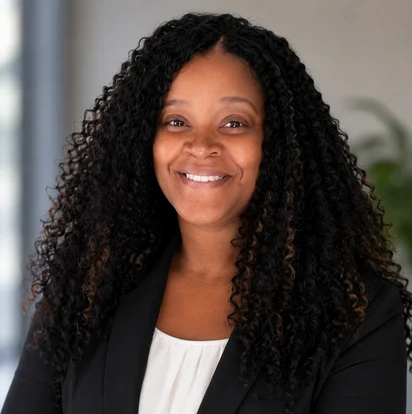
Nicole Brown is a community advocate who works with the 10P Program through 10P Warriors and Queens, and the co-founder and Community Enrichment Coordinator of Socc It to Autism.12 Her work focuses on young people and families shaped by childhood trauma, domestic violence, family separation, foster care involvement, incarceration and generational adversity.1
"You are not your past trauma. Your past may be part of your story, but it does not have to determine your future." — Nicole Brown1
Turning environmental triggers into triumph
Brown's starting point is that environments shape how people see themselves and respond to conflict. For children raised around instability, violence, neglect or incarceration, survival can become a learned behavior, and emotional triggers can form long before a child has words for what they feel.1 Without emotional literacy, she writes, "fear may present as anger, sadness as withdrawal, and emotional distress as aggression."1
She asks the questions that drive her work directly: "What happens when a child's survival response is mistaken for defiance? What happens when trauma is treated as a behavioral problem rather than an opportunity for intervention, understanding, and healing?"1 This is the same pattern 10P describes in Coping mechanisms and Trauma and emotional literacy.
"We cannot always change where our stories began," Brown says, "but we can help change how the next chapters are written."1
Breaking the foster care-to-prison pipeline
Brown names the foster care-to-prison pipeline, the pattern in which young people in the child welfare system face higher risk of school exclusion, juvenile justice involvement and incarceration.1 Through emotional literacy, restorative justice, mentorship and community-based intervention, she works to help young people develop:1
- Emotional awareness and self-regulation
- Healthy communication and conflict-resolution skills
- Accountability without shame or humiliation
- Positive identity, self-worth and confidence
- Empathy, resilience and meaningful relationships
- A sense of belonging beyond their circumstances
"Our young people deserve intervention before incarceration, understanding before judgment, and opportunities before punishment," she writes.1
Restorative justice
Brown is pursuing CAPCR training to facilitate victim-offender visits and dialogue.1 She describes this work as a carefully facilitated, trauma-informed space, entered voluntarily, where people affected by harm can be heard and accountability can be acknowledged. "Victim-offender dialogue is not about excusing harmful behavior or minimizing the experiences of victims and survivors," she writes.1 In her view, emotional literacy comes first: people cannot communicate their pain, recognize the pain of others or begin repairing harm without understanding their own emotions.
10P Warriors and Queens
Brown calls her commitment to 10P Warriors and Queens "deeply personal." Her vision for the work is to cultivate emotional literacy, personal accountability, self-advocacy, leadership and resilience, especially for young people navigating generational trauma, family disruption and the justice system.1
"A Warrior is not someone who has never been wounded. A Warrior is someone who learns that their wounds do not have to become their identity. A Queen is not defined by the adversity she has endured, but by her ability to recognize her worth, reclaim her voice, and walk in her purpose."1
Her stated purpose goes beyond teaching feelings words: to interrupt cycles of trauma, strengthen families, encourage restorative practices and open pathways away from incarceration and toward healing, education and opportunity.1 She sums up the work as "Turning Pain Into Purpose, Environmental Triggers Into Triumph, and Survival Into Empowerment."1
Socc It to Autism
As co-founder of Socc It to Autism, Brown helps lead an organization that supports the physical and social development of children with autism through safe, engaging physical activity, where children build confidence and social skills through play.2
Work with Nicole
To invite Nicole Brown to speak or partner with 10P Warriors and Queens, contact the 10P office at (530) 341-3226 or learnabout10p@gmail.com.
Put this into practice
 10P Program
Learn emotional literacy with 10P
Programs for prisons, youth, families, athletes, organizations and community circles. Read · Understand · Respond · Repeat.
See all programs
See also
Cite this entry: Samual Nathaniel Brown. “Nicole Brown.” The Emotional Literacy Encyclopedia, 10P Program, 2026-10-30. https://emotionalliteracy.org/encyclopedia/nicole-brown/