Encyclopedia · History & research
Trauma and emotional literacy
Unprocessed trauma does not go away. It goes underground — and comes back as behavior.

Trauma is an experience that overwhelms a person's capacity to cope. Emotional literacy matters to trauma because what a person cannot process, they tend to carry — and what they carry, they tend to act out.
Adverse childhood experiences
The Kaiser Permanente–CDC ACE study surveyed thousands of adult patients and found that childhood abuse, neglect and household dysfunction were common and strongly associated with later disease, mental illness and risky behavior.1 The researchers observed that behaviors such as smoking, drinking and drug use may be used "as a way of coping with damaging experiences."2
From trauma to coping
The Theory of Emotional Illiteracy-Based Criminality (TEIBC) builds directly on this. It holds that people adopt destructive Coping mechanisms — from addiction and compulsive buying to rage and crime — as ways of managing trauma they were never helped to process. The mechanism is the same regardless of the behavior: pain without words looks for an exit.
Processing through literacy
Emotional literacy does not erase trauma. It changes the relationship to it:
- Reading — naming what happened and what it left behind.
- Understanding — seeing how present reactions connect to old wounds.
- Responding — choosing constructive coping and, where needed, professional help.
- Repeating — practicing new responses until they become automatic.
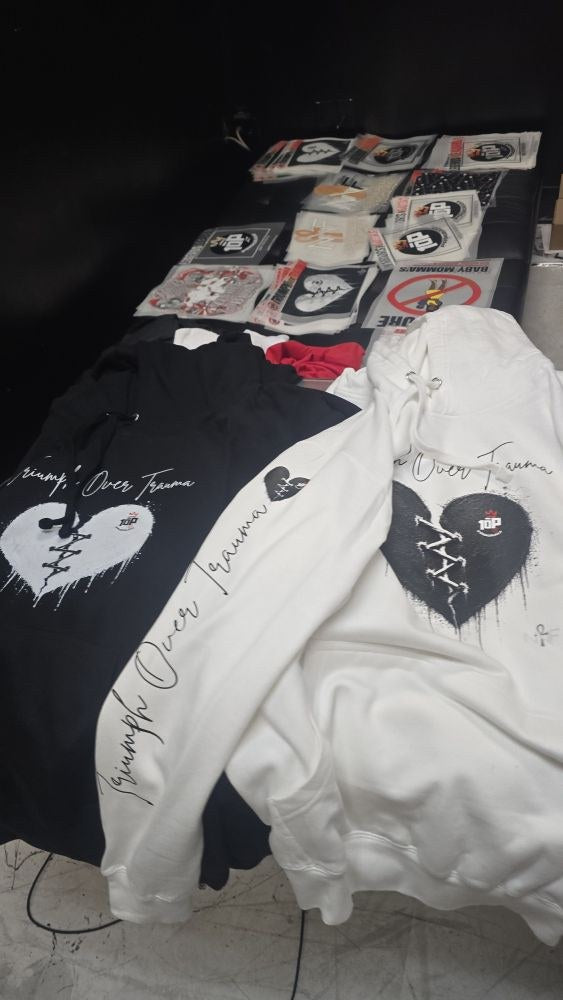
10P's phrase for the outcome is on one of its hoodies: Triumph Over Trauma.
Getting help
Emotional literacy is education, not therapy. If trauma is overwhelming your daily life, a licensed trauma-informed clinician can help. In the U.S., call or text 988 in a crisis.
-
Felitti, V. J., et al. (1998). American Journal of Preventive Medicine, 14(4), 245–258. doi:10.1016/S0749-3797(98)00017-8 ↑
-
Centers for Disease Control and Prevention. (1998). Adult health problems linked to traumatic childhood experiences. archive.cdc.gov ↑
Put this into practice
 New Nubian Fashions
Triumph Over Trauma Mended Heart Hoodie
Wear the work. A hoodie for everyone who has done the repair. $65.
Shop the hoodie
See also
Cite this entry: Samual Nathaniel Brown. “Trauma and emotional literacy.” The Emotional Literacy Encyclopedia, 10P Program, 2026-10-25. https://emotionalliteracy.org/encyclopedia/trauma-and-emotional-literacy/