Encyclopedia · Skills
Emotional expression
Saying what you feel in a way the other person can actually hear.
Emotional expression is the ability to communicate what you feel honestly and safely — neither bottling it up nor using it as a weapon.
Three styles
| Style | What it sounds like | What happens |
|---|---|---|
| Suppressed | "I'm fine." | The feeling goes underground and returns as resentment, illness or explosion. |
| Aggressive | "You always do this." | The other person defends instead of listening. |
| Literate | "I felt embarrassed when that happened in front of everyone." | The other person can understand and respond. |
Writing as expression
Expression does not have to be spoken. Psychologist James Pennebaker found that writing about emotional experiences for a few minutes a day was associated with improvements in health and well-being.1 See Feelings journal. In 10P's prison classrooms, writing — letters, poetry, the Power of the Pen course — is often where expression begins.
Culture and permission
Who is allowed to show what feeling is shaped by culture, gender and race. Many Black men in particular have been taught that showing hurt is dangerous. Emotional literacy does not ask anyone to be unsafe; it builds trusted spaces — circles, mentors, family — where expression is possible.
-
Pennebaker, J. W. (1997). Writing about emotional experiences as a therapeutic process. Psychological Science, 8(3), 162–166. doi:10.1111/j.1467-9280.1997.tb00403.x ↑
Put this into practice
 Community
Start a 10P circle
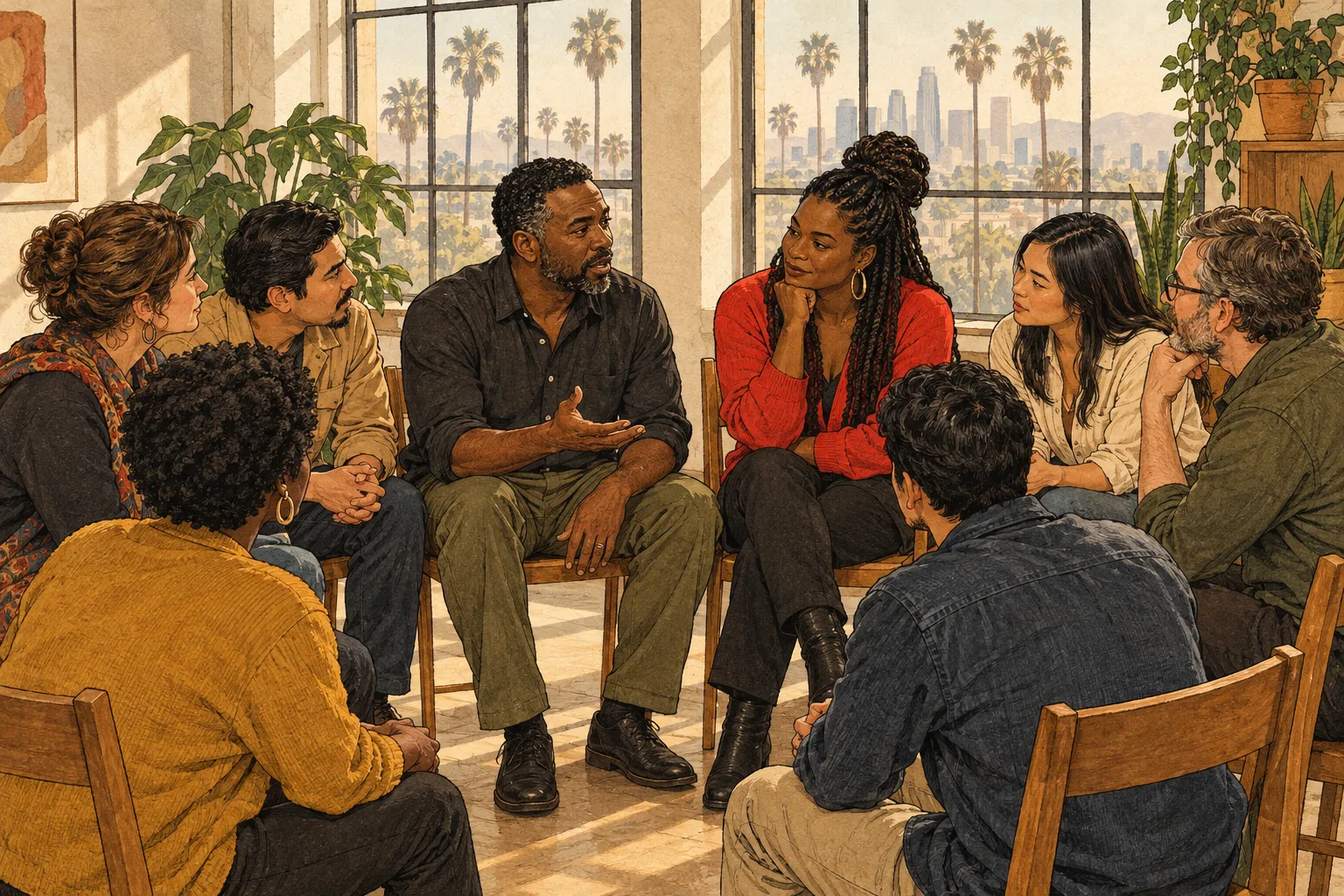
Community-led spaces to practice healing, accountability and connection. We help you launch and hold one.
Start a circle chapter
See also
Cite this entry: Samual Nathaniel Brown. “Emotional expression.” The Emotional Literacy Encyclopedia, 10P Program, 2026-10-25. https://emotionalliteracy.org/encyclopedia/emotional-expression/